Understanding Industrial Cleaning Regulatory Compliance Requirements for Safe and Compliant Facilities
Industrial cleaning regulatory compliance ensures that facilities meet legal safety and environmental standards, preventing costly penalties and health hazards through proper procedures and documentation. By understanding obligations from bodies such as OSHA, EPA, and FDA, businesses maintain safe workplaces, protect the environment, and uphold reputations. This guide covers why compliance matters, which agencies govern requirements, critical OSHA and EPA standards, industry-specific rules, and practical steps for implementation. Along the way, it highlights how professional services—like the disinfection and floor care solutions offered by Freedom Cleaning Solutions—support Central Florida organizations in achieving and maintaining full regulatory adherence.
Why Is Industrial Cleaning Regulatory Compliance Critical for Your Business?
Industrial cleaning regulatory compliance defines the processes and documentation that align cleaning operations with legal mandates. It prevents regulatory fines, safeguards employee health, and protects natural resources by enforcing correct handling, disposal, and sanitation methods. For example, a manufacturing plant that follows OSHA floor-care requirements reduces slip incidents and avoids citations, thereby sustaining productivity and morale.
What Are the Legal and Financial Risks of Non-Compliance?
Non-compliance with industrial cleaning regulations exposes businesses to severe legal actions and monetary penalties.
Before outlining specific penalties, consider this list of common financial and legal consequences:
- Monetary Fines Exceeding $10,000 per offense for hazardous waste violations.As of August 1, 2016, the maximum civil penalty for violations of the Resource Conservation and Recovery Act (RCRA) increased from $37,500 to $70,117 per day, per violation. (blog.idrenvironmental.com)
- Lawsuits from employees or neighbors for exposure injuries or environmental harm.
- Facility Shutdown Orders until corrective measures are approved.
These liabilities demonstrate that adherence to regulatory cleaning standards directly reduces risks and operational disruptions.
How Does Compliance Protect Employee Safety and Workplace Health?

Regulatory compliance promotes safe environments by mandating practices that control exposure to chemicals, biological hazards, and physical risks.
Key protective measures include:
- Proper chemical handling protocols based on Safety Data Sheets (SDS) to prevent respiratory and skin injuries.
- Slip-prevention floor maintenance using defined cleaning agents and slip-resistant procedures.
- Air quality management through approved ventilation cleaning schedules to limit airborne contaminants.
These controls enhance workforce well-being and align cleaning services with OSHA’s workplace safety focus.
Why Is Environmental Protection a Key Compliance Factor?
Environmental protection in industrial cleaning enforces responsible waste management to prevent soil, water, and air pollution.
Essential environmental requirements encompass:
- Secure hazardous waste containment and disposal to avoid groundwater contamination.
- Compliance with water discharge limits to protect local waterways.
- Proper chemical runoff controls during cleaning operations near storm drains.
Meeting these standards sustains ecosystem health and fulfills EPA obligations for clean operations.
How Does Compliance Enhance Your Business Reputation?
Demonstrating adherence to industrial cleaning regulations strengthens stakeholder confidence and competitive positioning.
Reputation benefits include:
- Enhanced customer trust from visible safety certifications and audit records.
- Competitive advantage when bidding for contracts that demand strict regulatory adherence.
- Positive brand image among local communities and regulatory agencies.
A robust compliance record translates into market differentiation and long-term business resilience.
What Are the Key Regulatory Bodies Governing Industrial Cleaning Compliance?
Industrial cleaning compliance relies on multiple agencies that establish safety, environmental, and sanitation standards. Understanding each regulator’s scope ensures complete alignment across operations.
How Does OSHA Ensure Workplace Safety in Industrial Cleaning?
OSHA governs workplace safety by setting enforceable cleaning standards and protocols that reduce injuries and exposures.
By enforcing these standards, OSHA mandates safe cleaning services that directly benefit both employees and facility managers.
What EPA Regulations Apply to Industrial Cleaning and Hazardous Waste?
The EPA regulates environmental aspects of cleaning through waste, water, and chemical control laws.
These regulations require documented procedures for waste disposal and chemical usage, ensuring environmental protection during cleaning operations.
Which FDA Cleaning Standards Affect Pharmaceutical and Food Processing Facilities?
FDA standards enforce strict hygiene and sanitation criteria to prevent contamination in highly sensitive industries.
Key requirements include:
- Title 21 CFR Part 211: Establishes current good manufacturing practice (cGMP) for pharmaceutical clean-in-place procedures.
- Hazard Analysis and Critical Control Points (HACCP): Mandates cleaning protocols to control food safety hazards.
- Food Code Sanitation Sections: Specifies equipment cleaning, facility sanitation, and microbial testing.
Compliance with these standards supports product safety, regulatory approvals, and consumer confidence.
FDA, USDA, and EPA Regulations for Food Industry Sanitation
The Food, Drug, and Cosmetic Act
covers food commodities except meat and poultry products from harvest through processing and distribution channels. Meat and poultry products are under the jurisdiction of the U.S. Department of Agriculture (USDA). Good Manufacturing Practices (GMPs) regulations are specific requirements developed to establish minimum criteria for sanitation practices. A number of statutes related to pollution control of the air, water, and other resources are enforced through the Environmental Protection Agency (EPA).Sanitation and the food industry, MW Schilling, 2018
Are There State and Local Compliance Requirements for Central Florida Businesses?
Florida enforces additional environmental and health regulations that complement federal mandates.
Important regional rules include:
- State Environmental Resource Permits for industrial wastewater discharges into surface waters.
- Florida Department of Environmental Protection water quality criteria for stormwater run-off management.
- Local health department guidelines for aerosol disinfection in healthcare and educational facilities.
Addressing these local regulations completes a comprehensive compliance strategy for Central Florida enterprises.
What Are the Most Important OSHA Industrial Cleaning Standards to Follow?
OSHA standards define specific operational, documentation, and training requirements for cleaning personnel and processes.
What Are OSHA Floor Cleaning Standards and Slip Prevention Protocols?
OSHA’s floor-care requirements mandate frequency, methods, and materials to maintain safe walking surfaces.
Key precautions include:
- Scheduling daily cleaning with approved detergents tailored to facility surfaces.
- Implementing slip-resistant matting in high-traffic areas.
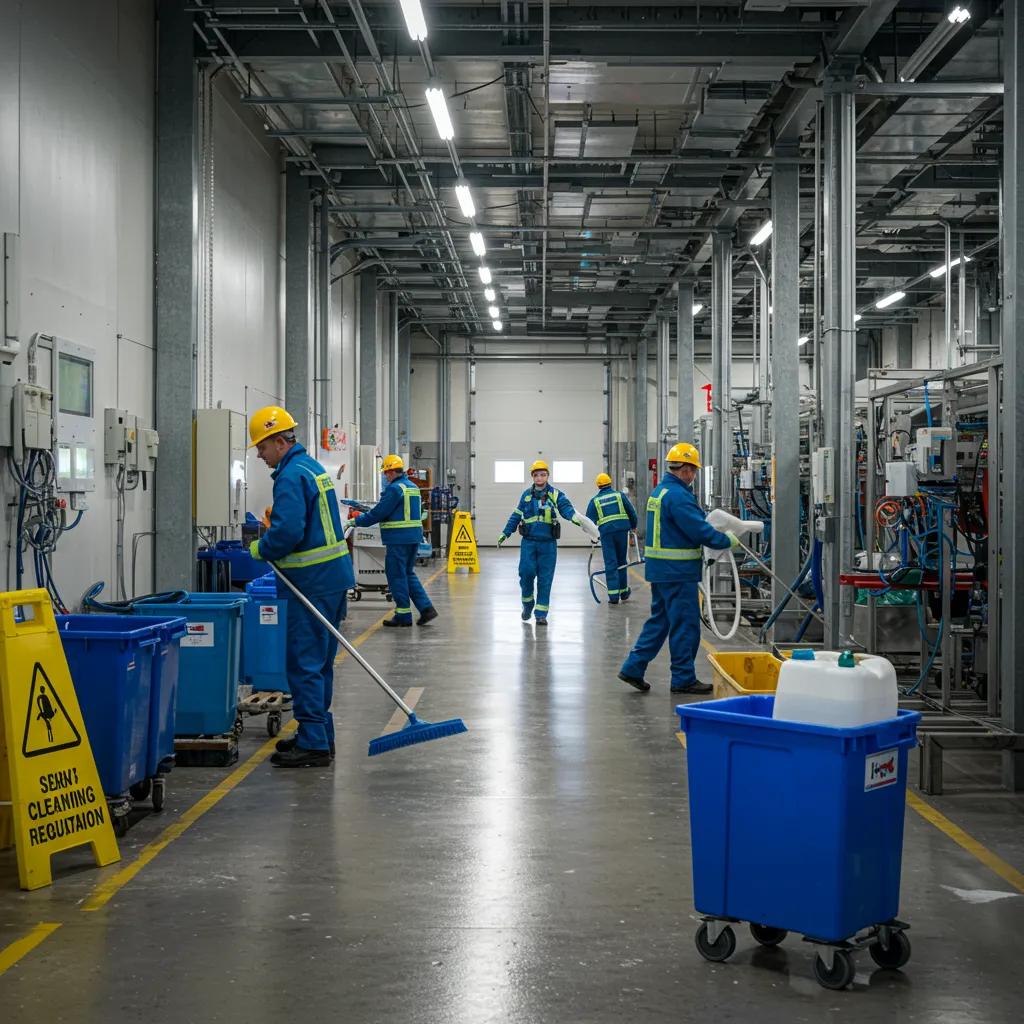
- Posting wet-floor signage and employing rapid-dry techniques.
These measures systematically reduce fall incidents and align floor care with federal safety mandates.
How Does OSHA Hazard Communication and SDS Compliance Work?
Hazard communication ensures that workers understand chemical risks through standardized documentation and training.
Core elements involve:
- Maintaining current Safety Data Sheets for every cleaning agent used.
- Labeling all chemical containers with hazard pictograms and signal words.
- Conducting regular employee training sessions on chemical handling and emergency procedures.
This structured approach empowers staff to manage cleaning chemicals safely and meet labeling rules.
What PPE Guidelines Does OSHA Mandate for Industrial Cleaning Workers?
OSHA specifies personal protective equipment based on identified hazards in cleaning operations.
Essential PPE requirements cover:
- Gloves resistant to chemical penetration and abrasion.
- Eye protection such as goggles or face shields during splashing tasks.
- Respiratory protection for airborne contaminant control in confined or poorly ventilated spaces.
Following these guidelines ensures worker safety and demonstrates adherence to occupational protection standards.
How Are Industrial Cleaning Safety Protocols and Risk Assessments Implemented?
A formal risk assessment identifies hazards and prescribes protocols to manage them effectively.
Implementation steps include:
- Conducting a walkthrough hazard analysis to catalog exposure points.
- Developing standard operating procedures that address chemical handling, equipment use, and emergency response.
- Instituting routine inspections and incident reporting mechanisms for continuous improvement.
This cycle of assessment and protocol integration embeds a culture of safety within cleaning operations.
How Do EPA Industrial Cleaning Regulations Impact Hazardous Waste and Environmental Safety?
EPA regulations shape how organizations handle cleaning by-products, promoting sustainable practices and pollution prevention.
What Are the Compliance Requirements for Hazardous Waste Disposal?
Proper disposal of hazardous waste demands classification, containerization, and transport protocols.
Key steps include:
- Conducting waste characterization testing to determine hazard class.
- Using labeled, sealed containers compliant with EPA storage specifications.
- Contracting certified transporters and disposal facilities for off-site treatment or incineration.
Adherence to these practices minimizes environmental risks and regulatory infractions.
How Does Green Cleaning Support EPA Environmental Responsibility?
Green cleaning integrates eco-friendly products and methods that reduce toxic residues and resource consumption.
Primary benefits include:
- Utilizing plant-based detergents that biodegrade without harmful by-products.
- Implementing microfiber technology to decrease water usage and chemical reliance.
- Choosing low-VOC formulations to limit air emissions and improve indoor air quality.
These strategies align cleaning workflows with EPA goals for sustainable operations.
What Are Water Discharge Regulations Relevant to Industrial Cleaning?
Industrial facilities must monitor and limit waterborne pollutants in cleaning effluent.
Critical requirements involve:
- Sampling wastewater streams for pH, chemical oxygen demand, and heavy metals.
- Treating runoff through sedimentation and filtration systems before release.
- Submitting discharge reports to environmental authorities per permit schedules.
Compliance with these controls safeguards local water sources from contamination.
How Are Chemical Products Regulated Under FIFRA and TSCA?
FIFRA and TSCA govern pesticide and industrial chemical use in cleaning applications.
Key regulatory distinctions include:
- FIFRA approval of disinfectants and sanitizers for specific environmental or surface uses.
- TSCA inventory requirements for industrial-scale chemical purchases and imports.
Meeting both statutes ensures legal deployment of cleaning agents without enforcement actions.
What Are the Industry-Specific Cleaning Regulations for Regulated Facilities?
Certain sectors demand tailored cleaning protocols that address unique contamination and safety risks.
What FDA Cleaning Standards Apply to Food Processing Facilities?
Food processing environments must follow sanitation steps that prevent cross-contamination and microbial growth.
Mandatory controls cover:
- Cleaning schedules synchronized with production cycles to avoid residue buildup.
- Validation testing of surface swabs for bacterial counts and allergen traces.
- Documentation of cleaning logs and corrective actions for non-conformances.
These measures deliver food safety assurances recognized by regulators and consumers.
How Is GMP Cleaning and Sanitation Enforced in Pharmaceutical Manufacturing?
Pharmaceutical facilities operate under stringent GMP guidelines to avert product contamination.
Core enforcement practices include:
- Using validated cleaning agents compatible with active pharmaceutical ingredients.
- Applying clean-in-place systems with automated process controls and verification steps.
- Conducting routine microbiological monitoring of critical contact surfaces.
Pharma-grade sanitation protocols maintain drug purity and regulatory compliance.
What Are the Compliance Requirements for Cleanroom Cleaning?
Cleanrooms require specialized cleaning regimens that control particulates and microbial levels.
Essential elements involve:
- Employing HEPA-filtered vacuum and wipe systems to remove ultra-fine particles.
- Wearing ISO-classified gowning and following air-lock entry procedures.
- Recording air-change rates and microbial sampling results for audit readiness.
Adherence to these criteria ensures the integrity of controlled environments.
How Do Medical Facility Disinfection Protocols Meet Regulatory Standards?
Healthcare settings apply disinfection standards to prevent healthcare-associated infections.
Standardized protocols consist of:
- Utilizing EPA-registered hospital disinfectants with defined contact times.
- Implementing high-touch surface cleaning schedules in patient care areas.
- Verifying disinfection efficacy through adenosine triphosphate (ATP) testing or other indicators.
Meeting these guidelines supports patient safety and infection control benchmarks.
How Can You Implement and Maintain Industrial Cleaning Compliance Effectively?
Implementing compliance relies on structured planning, training, auditing, and strategic partnerships.
What Are the Steps to Develop an Industrial Cleaning Compliance Plan?
A formal plan outlines objectives, responsibilities, and performance measures.
- Define regulatory scope by identifying applicable OSHA, EPA, FDA, and local rules.
- Map cleaning processes and hazards to regulatory requirements.
- Draft standard operating procedures with documented protocols and materials lists.
- Establish record-keeping templates for training, inspections, and incident reports.
- Review and approve the plan through management and safety committees.
A clear plan aligns daily operations with legal obligations.
How Should Industrial Cleaning Staff Be Trained and Certified?
Competent personnel form the foundation of compliant cleaning operations.
Training components include:
- Classroom instruction on regulatory standards and SDS interpretation.
- Hands-on sessions demonstrating proper equipment use, PPE donning, and waste disposal.
- Certification exams or skills assessments to validate proficiency.
Ongoing refresher courses maintain awareness of regulatory updates and best practices.
Why Is Auditing and Continuous Monitoring Essential for Compliance?
Regular audits and monitoring reveal gaps and enable prompt corrective actions.
Monitoring activities involve:
- Scheduled internal inspections of cleaning processes and documentation.
- Performance metrics such as incident rates, audit non-conformances, and corrective action timelines.
- Management review meetings to evaluate trends and implement improvements.
Continuous oversight embeds a culture of accountability and regulatory readiness.
What Are the Benefits of Partnering with a Compliant Industrial Cleaning Service?
Engaging a specialized provider ensures expert execution of regulatory protocols.
Key advantages include:
- Access to trained technicians who apply the latest OSHA and EPA standards.
- Reduced risk of non-compliance fines through documented service reports.
- Scalability and flexibility to adjust cleaning frequencies based on audit findings.
Freedom Cleaning Solutions provides tailored disinfection, floor care, and green cleaning services that uphold compliance requirements across industrial environments.
Professional partnerships streamline implementation and sustain a compliant facility environment.
Consistent adherence to industrial cleaning regulatory requirements prevents costly penalties, fosters employee well-being, and protects local ecosystems. By leveraging structured plans, trained personnel, rigorous audits, and expert cleaning partners, businesses create safer, more sustainable operations that enhance reputations and support long-term success.