
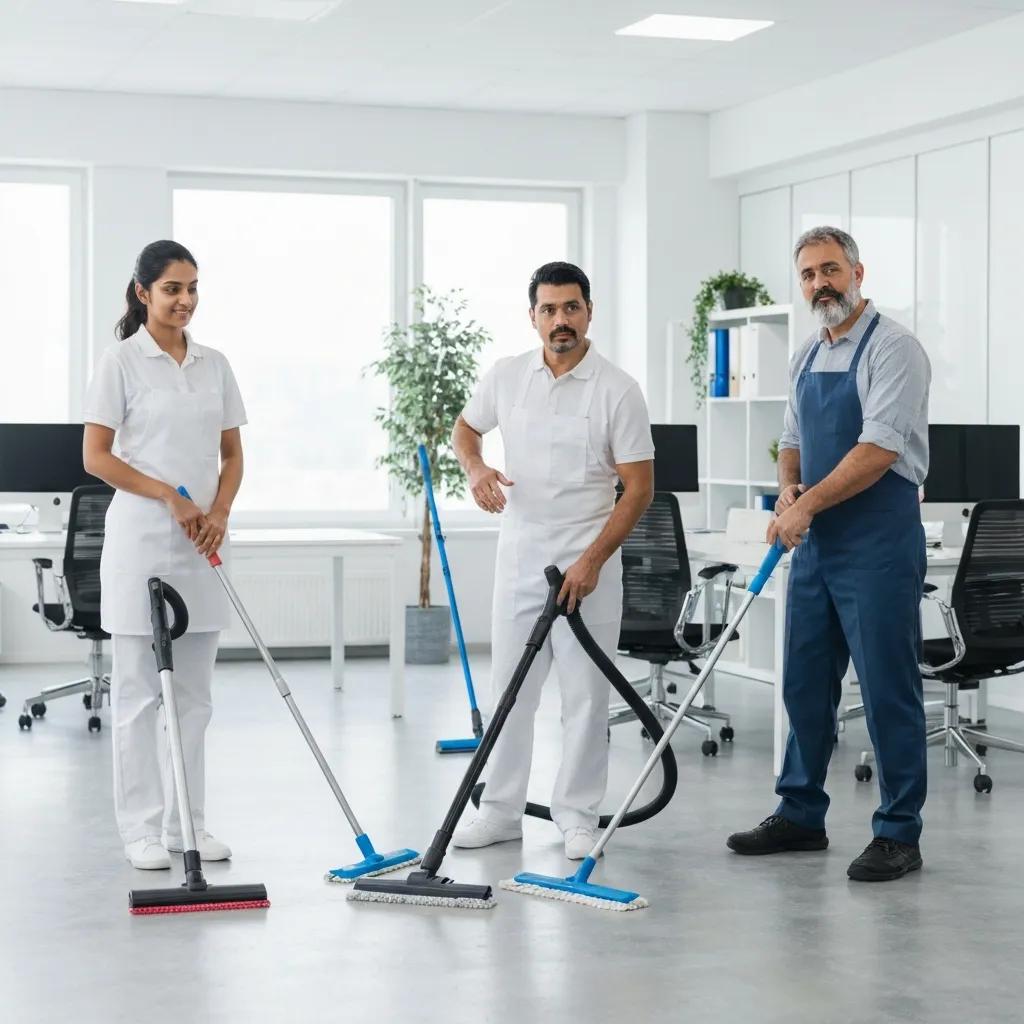
Cleanliness in a commercial setting is more than aesthetics; it directly affects health, productivity, and brand perception, and customer testimonials provide concrete evidence of those impacts. This article synthesizes five representative testimonial themes—office productivity gains, medical-grade disinfection outcomes, retail floor-care transformations, green cleaning benefits for schools, and broad business ROI—into case-style narratives that show mechanisms, measurable results, and operational lessons. Readers will learn how specific cleaning interventions work (the mechanism), why they matter for outcomes like reduced absenteeism and improved customer impressions (the reason), and what measurable signals to look for when evaluating a cleaning partner (the benefit). Each H2 section contains a short case-style explanation followed by H3 subsections that break down pre-engagement challenges and post-engagement results, with practical lists and EAV comparison tables that make it easy to compare interventions. Throughout, the piece uses commercial cleaning terminology—janitorial services, disinfection services, floor care, green cleaning—and maps testimonial language to service outcomes so facility managers and decision-makers can evaluate potential vendors using evidence-based criteria.
How Do Our Commercial Cleaning Services Boost Office Productivity?
Office cleaning improves productivity by removing physical and biological distractions, reducing allergens, and creating an environment that signals organization and care, which in turn supports focus and attendance. The mechanism starts with reducing surface contamination and airborne particulates through targeted janitorial routines and periodic deep cleans, which lowers irritation and illness transmission; the benefit is measurable gains in focus, fewer sick days, and a stronger first impression for visitors. Testimonial summaries from office clients emphasize fewer employee sick days and faster onboarding of visitors thanks to consistent schedules and attention to high-touch areas. Below we compare specific office interventions and their typical impacts to help decision-makers prioritize which actions deliver the strongest productivity returns.
What follows is a short comparison of common office cleaning interventions and their measured outcomes, using an EAV-style table for quick evaluation before we unpack client challenges and improvements in detail.
This comparison highlights how coordinated interventions form a layered defense: daily janitorial work prevents buildup, deep cleans reset the environment, and targeted services like carpet cleaning protect both health and appearance. Understanding these layers leads to a closer look at the initial pain points office clients commonly report.
What Challenges Did Our Office Clients Face Before Our Janitorial Services?
Before engagement, many office clients described a combination of visible and invisible issues: stained carpets and worn common areas, sporadic odors, and frequent minor illnesses that disrupted scheduling. These problems created operational drag—employees distracted by clutter, managers fielding complaints from visitors, and HR tracking higher-than-expected sick leave—so cleaning became both a morale and an operational issue. Testimonial summaries indicate clients often lacked a consistent cleaning cadence and had no documented procedures for high-touch areas, which magnified infection risk and reduced perceived professionalism. Addressing these challenges required a tailored plan that prioritized high-traffic zones, established predictable cleaning cycles, and set clear QA checks. The next subsection explains how consistent janitorial services changed the workplace dynamic and delivered measurable benefits.
How Did Consistent Janitorial Services Improve Workplace Morale and Focus?
Consistent janitorial services improved morale and focus by making the workplace predictable, reducing allergens, and removing visual clutter that distracts cognitive tasks. Mechanisms included scheduled daily cleaning that targeted shared equipment and breakrooms, periodic deep cleans that addressed hidden contaminants, and documented QA checklists that reassured staff. Testimonial themes show employees reported feeling safer and more valued when communal areas were kept clean, which translated into fewer interruptions and better sustained concentration. Measured indicators in client summaries included declines in short-term absenteeism and qualitative improvements in staff survey comments about comfort and focus. These outcome signals demonstrate that operational consistency, not occasional cleaning, is what drives workplace gains.
After seeing productivity improvements tied to janitorial routines, many readers ask how these outcomes map to service offerings; in practice, focused janitorial and consistent cleaning routines are core elements of Commercial Cleaning Services and are the first interventions recommended for office environments. This connection between outcome and service design sets up the hospital-grade disinfection discussion that follows.
Why Are Disinfection Services Critical for Medical Facility Safety?
Disinfection services are critical in medical settings because they eliminate or reduce pathogens on surfaces, lowering infection risk and directly supporting patient and staff safety. The mechanism uses trained staff applying appropriate hospital-grade disinfectants with correct contact times and validated protocols, which removes or inactivates target organisms; the benefit is measurable reductions in surface bioburden, fewer healthcare-associated contamination events, and increased patient confidence. Medical-facility testimonial summaries emphasize the value of protocols that combine cleaning and disinfection rather than relying on one-off sanitizing sprays. Below is a concise table comparing disinfection approaches and outcomes to clarify which methods address which pathogens and what results clients observed.
Chemical Disinfection Strategies for Infection Prevention
Chemical disinfection is an indispensable means of preventing infection. This holds true for healthcare settings, but also for all other settings where transmission of pathogens poses a potential health risk to humans and/or animals. Research on how to ensure effectiveness of disinfectants and the process of disinfection, as well as on when, how and where to implement disinfection precautions is an ongoing challenge requiring an interdisciplinary team effort.
Chemical disinfection in healthcare settings: critical aspects for the development of global strategies, S Bhattacharya, 2020
This table shows that combining methods—manual disinfection plus supplemental technologies—offers layered protection, which many medical clients referenced when reporting improved patient trust and lower environmental positives on swab tests. Next we examine a testimonial-style narrative that explains protocol steps and perceived patient outcomes.
How Did Our Hospital-Grade Disinfection Eliminate Pathogens and Build Patient Confidence?
A recurring testimonial theme from medical clients highlights the strict sequence of cleaning followed by disinfection, with trained personnel documenting contact times and material compatibility to ensure efficacy. The protocol begins with cleaning to remove soils that can shield pathogens, followed by an EPA-registered hospital-grade disinfectant applied at the recommended dwell time; staff training and checks ensure consistency and documentation. Clients reported that staff and patients noticed the consistent procedures—visible logs, labeled schedules, and trained personnel—which increased perceived safety and trust during care interactions. Quantifiable outcomes included environmental test improvements and anecdotal reports of fewer contamination-related events, illustrating that disciplined protocols yield both technical and perception-based benefits. Understanding these measurable effects leads into the specific health benefits medical facilities tracked after implementing enhanced disinfection.
What Measurable Health Benefits Did Medical Clients Experience?
Medical clients tracked several measurable health and safety outcomes after adopting rigorous disinfection regimens: reductions in surface microbial counts, fewer environmental contamination incidents, and improved staff confidence in infection prevention protocols. Typical metrics cited in testimonial summaries included declines in routine surface positives and fewer precautionary closures for deep cleaning, although exact figures are client-specific and tracked internally. These measurable benefits translated into operational advantages: smoother clinic flow, fewer last-minute room closures, and an observable lift in patient satisfaction related to cleanliness. Short numbered lists help summarize the primary benefits that medical clients highlighted after program adoption.
- Reduced surface contamination: documented decreases in routine environmental swabs.
- Lower operational disruptions: fewer closure events for deep sanitation.
- Increased patient and staff confidence: improved satisfaction comments related to cleanliness.
These listed outcomes illustrate how disinfection services directly affect both hard safety metrics and softer confidence signals; the next section examines the retail floor-care outcomes that drive customer experience and sales.
After reviewing disinfection outcomes and their link to medical safety, note that these results also reflect the broader category focus of Commercial Cleaning Services when applied in healthcare contexts; aligning service scope with safety needs is essential for measured improvement.
How Has Professional Floor Care Transformed Retail Spaces?
Professional floor care transforms retail environments by restoring surfaces to safe, attractive conditions that influence customer behavior, reduce slips and trips, and preserve flooring assets. The mechanism combines corrective actions—strip and refinish, burnishing, grout cleaning—with routine maintenance to maintain slip resistance and aesthetic appeal; the benefit includes improved customer perception, reduced liability, and potentially increased dwell time and spend. Retail testimonial summaries repeatedly point to before/after differences in floor appearance and maintenance costs, where strategic interventions corrected long-term neglect and created a better shopping environment. Below is an EAV-style table comparing floor-care actions to customer-perception and operational outcomes so managers can weigh costs against expected business impacts.
The table clarifies that both corrective and routine actions are necessary: corrective work resets the baseline and routine maintenance sustains the benefit, a pattern that retail clients emphasized when discussing sales floor improvements. The following subsections break down typical floor challenges and how maintenance choices changed customer experience and sales environment metrics.
What Floor Care Challenges Did Retail Clients Encounter?
Retail clients often faced worn finishes, visible scratches, and inconsistent slip resistance that undermined the storefront experience and sometimes triggered safety complaints. These issues stemmed from heavy foot traffic, inadequate maintenance routines, and delayed corrective interventions, which accelerated wear and raised cleaning costs over time. Testimonial summaries highlighted retailers who initially prioritized cosmetic fixes but later recognized the need for systematic floor maintenance plans that balanced preventive care with occasional restorative work. The operational consequence was clear: neglected floors depress perceived value and can deter repeat visits, so addressing both appearance and safety became a priority. The next subsection outlines the measurable ways that meticulous maintenance improved customer experience and sales.
How Did Meticulous Floor Maintenance Enhance Customer Experience and Sales?
Meticulous floor maintenance enhanced customer experience by improving visual appeal, stabilizing slip resistance, and reinforcing a brand’s professional image; customers respond to consistent cleanliness with longer visits and higher purchase rates. Mechanisms included scheduled buffing to retain shine, routine stripping and refinishing to protect surfaces, and targeted spot restoration for visible defects. Retail testimonial themes show managers reporting more favorable customer comments, smoother in-store navigation, and decreased slip-and-fall incidents after maintenance plans were implemented. Recommended maintenance schedules—daily light care, weekly polishing, and periodic restorative cycles—help maintain both safety and aesthetics, which supports sales floor effectiveness. These operational improvements naturally segue to discussions of green cleaning in education contexts, where both health and sustainability goals intersect.
What Are the Benefits of Green Cleaning for Educational Institutions?
Green cleaning benefits schools by reducing exposure to volatile organic compounds (VOCs) and irritants, improving indoor air quality, and supporting student health and attendance; the mechanism is substitution of eco-friendly products and procedures that minimize airborne and surface toxins, leading to fewer allergy and asthma triggers. Testimonial summaries from school administrators emphasize fewer allergy complaints, better indoor air parameters, and alignment with environmental goals. Below is a short EAV-style table showing environmental program elements and typical results so facilities can match interventions to sustainability targets.
This table demonstrates that product selection, application methods, and personnel training together create measurable environmental benefits. The two H3 subsections that follow unpack the IAQ and sustainability outcomes schools observed after implementing green programs.
How Do Eco-Friendly Products Improve Indoor Air Quality and Student Well-Being?
Eco-friendly products improve indoor air quality and student well-being by reducing VOC emissions and limiting residues that can trigger respiratory irritation, particularly in sensitive populations like children. Mechanisms involve substituting low-VOC formulations and using microfiber systems that reduce the need for chemical volumes; outcome measures include fewer reported allergy incidents and improvements in perceived air freshness in administrative surveys. Testimonial summaries from schools cite anecdotal drops in nurse visits for allergy symptoms and improved concentration during classes, linking cleaner air to better learning conditions. These practical IAQ improvements are part of a broader sustainability strategy many schools adopt to meet policy goals and community expectations. The next subsection addresses how such programs support formal environmental targets.
How Has Sustainable Cleaning Helped Schools Meet Their Environmental Goals?
Sustainable cleaning programs help schools meet environmental goals by lowering chemical consumption, reducing packaging waste, and documenting improvements for environmental reporting, which supports broader sustainability commitments. Operational steps include selecting certified products, implementing dilution-control systems, and training staff on efficient application to avoid overuse—actions that also reduce procurement costs over time. Testimonial themes indicate that schools appreciated visible metrics (reduced liters of harsh chemicals purchased, fewer disposal events) and used those signals in sustainability communications to stakeholders. These program elements not only support health outcomes but also align cleaning practice with district-level environmental policies and public expectations, which reinforces the strategic role of cleaning in institutional sustainability.
How Does Our Comprehensive Commercial Cleaning Support Overall Business Success?
Comprehensive commercial cleaning supports business success by combining customized schedules, specialty services, and quality assurance to protect assets, support employee retention, and preserve brand reputation. The mechanism relies on tailored plans that mix routine janitorial work with specialty services—carpet care, disinfection, floor maintenance—and regular QA audits that ensure consistency; the benefit is long-term cost control, fewer disruptions, and measurable preservation of facility assets. Client testimonial summaries across industries point to long-term partnerships as a driver of operational predictability and lower total cost of ownership for facilities. The two H3 subsections below explain customization options and how clients characterize reliability and lifetime value.
What Customized Solutions Do We Provide to Meet Diverse Business Needs?
Customized solutions include adjustable cleaning frequencies, scope options for specialty services, and industry-specific protocols that align with client operations—medical facilities receive hospital-grade disinfection, retail gets floor-care schedules, and schools adopt green cleaning programs. The mechanism for customization uses needs assessments, walkthroughs, and performance metrics to create a plan that balances cost, timing, and outcome priorities. Testimonial summaries indicate that clients value providers who adapt schedules to shift patterns and minimize disruption, using checklists and documented scopes to ensure expectations are met. This tailored approach reduces wasteful tasks, focuses resources on high-impact areas, and supports operational continuity. The next subsection summarizes how clients describe reliability and long-term value from such partnerships.
How Do Clients Describe Our Reliability and Long-Term Value?
Clients consistently highlight reliability, responsiveness, and predictable quality as key value drivers that justify ongoing contracts and renewals; the mechanism is a documented QA process, trained staff, and communications protocols that create trust. Testimonial themes emphasize on-time performance, consistency in quality across visits, and remediation processes when issues arise, which together contribute to perceived long-term savings and reduced procurement churn. Typical client language notes that dependable cleaning reduces administrative time spent on vendor management and helps maintain asset conditions that would otherwise require more costly repairs. Summarizing these points, reliability is the operational backbone that transforms cleaning from a commodity to a strategic facility service.
- On-time scheduled service: predictable site presence and fewer surprises.
- Documented quality checks: QA logs and corrective action records.
- Responsive issue remediation: rapid follow-up when clients report concerns.
These indicators point to how consistent operational processes build long-term client trust and cost-effective facility stewardship. The next section focuses on veteran-owned differentiators that many clients reference when choosing a vendor.
What Makes Freedom Cleaning Solutions Stand Out as a Veteran-Owned Cleaning Company?
Freedom Cleaning Solutions LLC positions veteran-owned values—discipline, accountability, and mission focus—into service delivery practices that enhance consistency and trust. The mechanism translates military-derived systems into checklists, chain-of-command quality controls, and structured training; the benefit is measurable reliability and a culture of continuous improvement that clients repeatedly reference in feedback. As a veteran-owned and operated firm serving Central Florida with services including 24/7 janitorial services, carpet cleaning, disinfection services, floor care, and green cleaning, the company connects these operational strengths to business outcomes in client engagements. Below are core UVPs and how they translate to client benefits.
- Veteran-Owned and Operated: disciplined operations and mission-focused service delivery.
- Customized Cleaning Plans: tailored scheduling and scopes that align to industry needs.
- 100 percent Satisfaction Guarantee & Trained and Vetted Staff: quality assurance and client confidence.
These value propositions summarize why clients often cite the company’s reliability and standards when describing results; the next subsections unpack how military discipline and guarantees manifest in daily operations.
How Does Military Discipline Enhance Our Cleaning Service Quality?
Military discipline enhances service quality through standardized procedures, clear chains of responsibility, and rigorous checklists that reduce variation and improve accountability. Mechanisms include shift handoff protocols, supervisory spot checks, and documented corrective actions that ensure every task meets defined standards, which clients interpret as consistent quality across service visits. Testimonial summaries often reflect appreciation for predictable outcomes—cleaning tasks completed right the first time—reducing client oversight and enabling managers to focus on core business tasks. These disciplined processes create a reliability advantage that directly affects client experience and operational continuity. The next subsection outlines the guarantees and training that support those processes.
What Guarantees and Staff Training Ensure Client Satisfaction?
Guarantees and staff training ensure satisfaction by combining vetted hiring practices, role-specific training, and a remediation process that addresses deviations from service expectations. Training topics emphasize safety, correct product use, and customer-facing professionalism, while guarantees offer a clear path for clients to request remediation if standards are not met. Testimonial summaries cite these elements as trust signals: when staff are trained and a satisfaction guarantee exists, clients report faster issue resolution and greater confidence in long-term service commitments. By operationalizing training and guarantees, the organization turns abstract promises into measurable outcomes that clients can verify through routine QA checks and communication channels.
How Do Customer Testimonials Prove the Effectiveness of Our Cleaning Services?
Customer testimonials collectively prove effectiveness by revealing consistent outcome patterns—health improvements, productivity gains, enhanced customer perception, sustainability alignment, and service reliability—that map directly to specific cleaning services and measurable metrics. The mechanism tying testimonials to evidence is pattern recognition: when multiple clients across industries report similar benefits after comparable interventions, those testimonials function as mutually reinforcing data points that validate the service model. Summarizing the five testimonial themes makes it easy for decision-makers to see which services produce which results and to request similar outcomes for their facilities. Below is a bulleted synthesis of cross-cutting benefits drawn from testimonial language and practical takeaways for facility leaders.
- Health & Safety Improvements: Reduced surface contamination and fewer reported illness events after disinfection protocols.
- Productivity Gains: Decreased absenteeism and improved employee focus tied to consistent janitorial schedules.
- Customer Experience Enhancements: Retail floor shine and odor control that improve first impressions and dwell time.
- Sustainability Outcomes: Schools reporting improved IAQ and fewer allergy complaints through green cleaning adoption.
- Reliability & Value: Clients valuing predictable quality and long-term cost savings from comprehensive cleaning plans.
These takeaways summarize how testimonial themes map to operational services and measurable outcomes, and they form the basis for a practical next step: requesting service evaluations or quotes tied to desired results. For readers ready to pursue similar outcomes, remember that “Commercial Cleaning Services” is the primary service category demonstrated by these testimonial patterns and serves as a bridge to any quote or discovery conversation.
What Key Benefits Do Clients Highlight in Their Reviews?
Clients most frequently highlight benefits related to cleanliness, reliability, responsiveness, and demonstrable improvements in health or perception metrics; testimonial language tends to emphasize specific service mentions such as disinfection, floor care, and green cleaning when noting results. These benefits map directly to operational interventions: disinfection reduces pathogens, floor care improves appearance and safety, and green cleaning supports IAQ and sustainability goals. Testimonial summaries often include quantifiers—fewer sick days, less slip-and-fall risk, or improved visitor comments—though exact figures are typically tracked in client records. Presenting benefits in a short list helps procurement teams identify priority outcomes to include in RFPs or service agreements.
- Cleaner environments: noticeable improvement in visible surfaces and odors.
- Reduced illness-related disruptions: fewer short-term absences reported.
- Enhanced customer impressions: better storefront and lobby experiences.
These listed points provide a practical lens for evaluating cleaning proposals and matching services to business objectives. The following subsection connects these testimonial patterns to the regional scale of Central Florida operations.
How Do Testimonials Reflect Our Impact Across Central Florida Businesses?
Testimonials reflect regional impact by showing a consistent industry spread—offices, medical clinics, retail stores, and schools across Central Florida—that validates service adaptability to diverse operational needs. Patterned testimonial themes indicate that the same service design principles (customization, QA, trained staff) translate across industries, with localized adjustments for schedules or regulatory requirements. One-line descriptors commonly used in client summaries include industry + outcome (for example: office — reduced absenteeism; medical — improved environmental test results; retail — restored storefront aesthetics), which helps prospective clients in Central Florida assess relevance quickly. These regional patterns support confidence that similar interventions can be deployed across Orlando, Daytona Beach, Kissimmee, and adjacent markets with predictable results.
After synthesizing testimonial evidence, readers often ask practical questions about evaluating vendors and interpreting testimonials; the next H2 addresses those frequently asked queries with concise, extractable answers ideal for decision-making.
What Frequently Asked Questions Do Clients Have About Our Commercial Cleaning Effectiveness?
Clients commonly ask why testimonials matter, how effectiveness is measured, and what ROI to expect; concise answers help procurement teams extract actionable signals from reviews and make better vendor choices. The mechanism for answering PAA-style questions is to combine evidence-based indicators (metrics, QA logs, measurable outcomes) with practical evaluation tips so readers can validate vendor claims quickly. Below are succinct Q&A entries designed for quick consumption and featured-snippet potential, followed by an H3 discussion that explains testimonial interpretation and productivity links.
- Why are testimonials important? They provide peer evidence of consistent performance and contextualize how services solved real operational problems.
- How is effectiveness measured? Through metrics such as reduced absenteeism, environmental swab results, IAQ indicators, and customer feedback surveys.
- What ROI can be expected? ROI derives from preserved assets, fewer operational disruptions, and improved employee productivity, though exact returns depend on baseline conditions.
These concise answers give procurement teams immediate criteria for evaluating cleaning partners and set expectations for measurable outcomes. The two H3 subsections expand briefly on why testimonials matter and how cleaning links to productivity.
Why Are Customer Testimonials Important for Choosing a Cleaning Service?
Customer testimonials are important because they translate abstract service promises into demonstrated outcomes within comparable operational contexts, offering social proof and tangible examples of problem→solution→result sequences. Testimonials that contain specifics—what the problem was, which intervention was used, and what measurable result followed—are the most valuable for decision-makers. Practical tips for interpreting testimonials include looking for industry similarity, checking for measurable outcomes, and confirming whether the vendor can reproduce the documented process. These guidelines help readers go beyond praise to evaluate whether a provider can deliver the same operational benefits in their facility.
How Can Professional Cleaning Boost Employee Productivity and Business Image?
Professional cleaning boosts employee productivity by reducing allergens and infectious exposures, minimizing distractions from messy or cluttered spaces, and signaling an organized workplace that supports focus and morale. Mechanisms include improved IAQ, removal of surface contaminants, and consistent appearance that reduces stress and interruptions; business-image effects include better first impressions for clients and enhanced brand professionalism in public areas. Research and testimonial patterns indicate that these mechanisms combine to produce measurable productivity and perception improvements, making cleaning an operational lever rather than a simple overhead expense. For organizations prioritizing both employee well-being and customer-facing impression, investing in targeted cleaning strategies yields compounded returns.
This article has presented structured testimonial themes, EAV comparisons, and practical lists that enable facility leaders to match desired outcomes to the appropriate services. For readers ready to pursue similar improvements, consider documenting baseline metrics (absenteeism rates, IAQ measurements, customer feedback) to track the impact of any service engagement and to enable evidence-based decisions.



https://shorturl.fm/snqri
I’m Ashley, writing on behalf of the CEO of EmpowerMe, Trenton Wisecup. He’s holding an AI and automation masterclass on how to integrate AI and scale your business for 2026. For us, AI isn’t just a buzzword – it’s the engine. Trenton used these systems to scale his own company to an 8-figure business.
To show you how, he’s running a “no-fluff” webinar for those who don’t want to be left behind in the modern-day battlefield of business. To ensure quality, we are capping attendance at 50 participants.
Secure your spot by replying “Awaken.”
Ashley
https://shorturl.fm/XpEGE
https://shorturl.fm/RDwlv
Solid analysis! Thinking about player psychology is key in tournaments. Seeing platforms like ph987 games focus on localized experiences & security is smart-trust builds action at the tables. Good read!
https://shorturl.fm/oz3RY
It’s fascinating how easily we fall into patterns when “playing,” isn’t it? The instant gratification cycle is strong. Platforms like i8 club apk seem designed to tap into that, offering quick, accessible games. Understanding those psychological triggers is key to responsible enjoyment!