
How Many Hours Should Professional Cleaners Spend on a 1,000 Sq Ft Workspace? Comprehensive Time Estimates and Influencing Factors
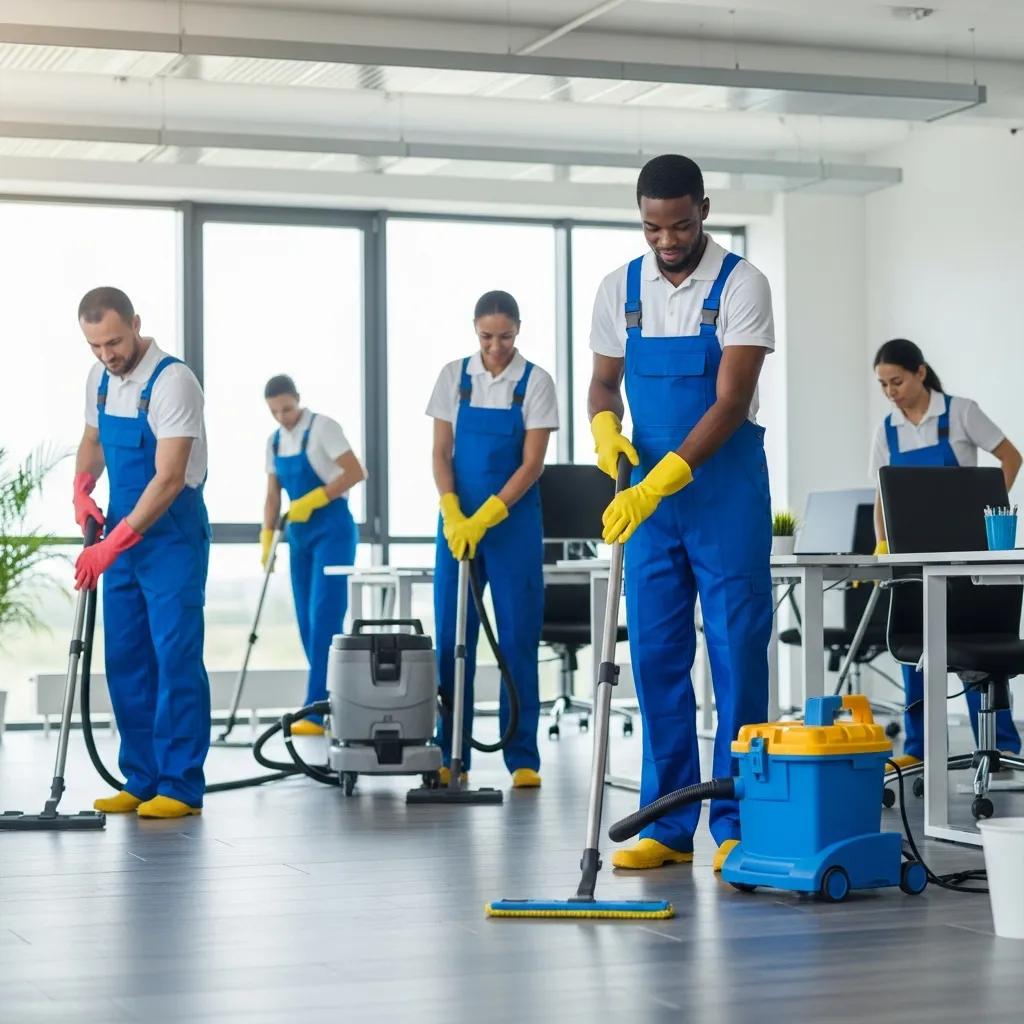
A professional cleaning crew can typically complete a standard, basic cleaning of a 1,000 sq ft commercial workspace in roughly 1 to 2 hours, while a deep clean or full disinfection usually requires 2 to 4 hours depending on scope and traffic. This range reflects the core variables that change time estimates: facility type, cleaning scope, frequency, layout complexity, and required specialized tasks. Knowing realistic time estimates helps facility managers budget labor, schedule around operations, and choose whether to outsource to janitorial services or maintain in-house staff. This article explains the main factors that influence cleaning time, provides benchmark ranges for offices, medical, and retail spaces, and shows how productivity benchmarks (sq ft per hour) translate into staffing and pricing. You’ll also find a practical table of benchmarks, a factors table quantifying time impact, and actionable guidance on calculating time and selecting the right number of cleaners. Throughout, targeted terms such as commercial cleaning services, how long to clean 1000 sq ft, and office cleaning duration 1000 sq ft are used to help you compare providers and arrive at accurate estimates.
What Factors Influence the Cleaning Time for a 1,000 Sq Ft Workspace?

Cleaning time for a 1,000 sq ft workspace is primarily driven by a short list of high-impact factors that directly change the amount of labor required per visit. These factors operate by increasing task volume (high traffic, many restrooms), introducing specialized processes (disinfection, floor care), or reducing crew productivity (complex layout, furniture density), all of which extend elapsed cleaning hours. Identifying the dominant factors during a site walk-through lets managers apply time multipliers to base productivity rates and arrive at defensible estimates for staffing and scheduling. The following list highlights the most important variables to assess during planning and procurement.
Key factors that influence cleaning time include:
- Facility type and regulatory requirements such as medical disinfection or retail floor care.
- Daily foot traffic and peak-hour turnover that increase cleaning frequency and tasks.
- Cleaning scope (basic light clean vs. deep clean/disinfection) and required add-ons.
- Layout complexity, furniture density, and number of enclosed rooms or restrooms.
These factors interrelate—understanding one often clarifies another—so a systematic site assessment provides the best starting point for precise time estimates.
Intro to the factors table: The table below quantifies typical variations each factor introduces so you can see approximate time impacts in hours.
| Factor | Typical Variation | Impact on Time |
|---|---|---|
| Traffic (low/medium/high) | Low/Moderate/Heavy | +0h / +0.5h / +1–1.5h |
| Scope (basic/deep/disinfection) | Basic/Deep/Disinfect | Base / +0.5–1.5h / +1–2.5h |
| Layout complexity | Open-plan / Mixed rooms | – / +0.5–1h |
| Restroom count | 0–1 / 2+ | 0 / +0.5–1h |
| Floor care needed | Vacuum only / Stripping/polish | +0–0.5h / +1–2h |
Summary of factor impacts: Traffic and scope are usually the largest single drivers, with specialized floor work and multiple restrooms producing consistent time increases that should be budgeted explicitly.
How Does Facility Type Affect Cleaning Duration?
Facility type defines both the tasks required and the level of regulatory or customer-facing scrutiny those tasks receive, which changes cleaning duration in predictable ways. Offices typically require surface cleaning, trash removal, vacuuming, and restroom servicing, making them among the faster routine cleans; medical clinics and some retail environments demand more intensive disinfection, exam-room turnover, or merchandising-area maintenance that add time. The mechanism behind these differences is straightforward: clinical and high-traffic public settings add procedural steps (e.g., contact-time disinfection, patient-room changeover) and sometimes stricter documentation, which lengthens each visit. For practical planning, treat medical and busy retail venues as adding a 30–90 minute premium per 1,000 sq ft visit versus an equivalent office layout. Understanding facility-specific tasks helps you select the right cleaning scope and acceptable per-visit time.
Transition to scope and frequency: After clarifying how facility type changes tasks, the next key variable to examine is cleaning scope and frequency, since these directly alter per-visit labor and monthly totals.
What Role Do Cleaning Scope and Frequency Play in Time Estimates?
Cleaning scope and frequency define the intensity and recurrence of labor, creating a trade-off between per-visit time and overall monthly workload. A basic light clean—dusting, trash, vacuuming, quick restroom check—usually sits at the low end of time estimates and is efficient when conducted daily, because recurring upkeep reduces buildup. By contrast, deep cleans and terminal disinfection include tasks such as high-touch sanitization, baseboards, and floor treatment, adding substantial time per visit but required less often. Frequency acts as a multiplier: increasing visit cadence (e.g., daily vs. weekly) typically reduces the time needed for each visit while increasing monthly aggregate hours. For budgeting, apply scope multipliers (basic = 1.0, standard janitorial = 1.3, deep/disinfection = 1.8–2.5) to baseline productivity rates to estimate per-visit durations.
List intro: Use these scope categories to match expected per-visit times and choose frequency that balances cost and cleanliness.
- Basic Light Clean: Quick dust, trash removal, vacuum — efficient for daily schedules.
- Standard Janitorial: Includes full restroom servicing, spot mopping, and surface detail.
- Deep Clean/Disinfection: Thorough sanitization, detailed floor care, and hard-to-reach cleaning.
Summary: Selecting the correct scope and frequency for your facility reduces surprises in per-visit time and improves consistency in monthly labor budgeting.
What Are the Average Cleaning Time Benchmarks for a 1,000 Sq Ft Workspace?
Average benchmark ranges translate productivity metrics into practical expectations: for many providers, basic office cleaning runs approximately 1–2 hours per 1,000 sq ft, standard janitorial visits fall in the 1.5–2.5 hour range, and deep clean/disinfection visits often require 2–4 hours depending on added services. These ranges reflect typical sq ft-per-hour productivity rates that vary by task mix—vacuuming and surface wipe-downs yield higher speeds, while restroom-intensive or floor-restoration work reduces speed. Benchmarks work as planning anchors: supply-side providers commonly price and schedule around these ranges, and managers should verify assumptions about furniture density, restroom counts, and special services before accepting estimates. Below is a table presenting benchmark times by facility type and scope to make quick comparisons.
Intro to benchmark table: This table shows practical time ranges to expect for common facility types and cleaning scopes for a 1,000 sq ft space.
| Facility Type | Cleaning Scope | Estimated Time Range |
|---|---|---|
| General Office | Basic visit | 1.0 – 2.0 hours |
| General Office | Deep / Disinfection | 2.0 – 3.5 hours |
| Medical Clinic | Standard visit (includes disinfection) | 1.5 – 3.0 hours |
| Retail Space | Basic + floor care | 1.5 – 3.0 hours |
| Retail w/ heavy floor care | Deep floor treatment | 2.5 – 4.0 hours |
Key insight: Use the table to set realistic expectations and to ask providers how they account for unique tasks when quoting time and price.
Business integration (benchmarks context): Freedom Cleaning Solutions LLC maps these generic benchmarks to real-world scheduling by offering custom schedules and packages—daily, weekly, monthly, or one-time—that match scope to client needs and produce tailored per-visit time estimates. Requesting a site-specific estimate ensures the benchmark range is refined into a precise staffing and timing plan.
How Long Does It Take to Clean a General Office Space of 1,000 Sq Ft?
A typical open-plan 1,000 sq ft office with moderate furniture density and one restroom will usually require about 1 to 2 hours for a standard basic cleaning, assuming routine daily or weekly maintenance. This estimate includes vacuuming, trash removal, surface wipe-downs, restroom servicing, and spot-mopping; denser furniture arrangements or multiple enclosed offices add time toward the upper end of the range. For a weekly standard janitorial visit that includes more detailed surface work and floor attention, plan for 1.5–2.5 hours. When calculating scheduling windows, build a 10–20% buffer to account for variable traffic and occasional deep-clean tasks that arise between scheduled deep visits.
Transition to medical/retail comparison: Office timing clarifies baseline productivity, and the next subsection outlines why medical and retail spaces typically need more time per visit.
What Are Cleaning Time Estimates for Medical and Retail Spaces?
Medical and retail spaces commonly require additional labor steps that push time requirements higher than general offices, often by 30–60% or more. Medical clinics need rigorous disinfection protocols, exam-room turnover procedures, and sometimes documentation, which can make a 1,000 sq ft medical suite take 1.5–3 hours depending on patient flow and the number of rooms. Retail spaces add public-area floor care, display dusting, and customer-facing touchpoints that require careful cleaning during off-hours to avoid disruption; retail basic visits can run 1.5–3 hours and deep floor work extends that further. For planning, treat these facility types as requiring scope-level adjustments and verify whether the provider includes infection-control methods or specialized floor equipment in their time estimates.
How Does Freedom Cleaning Solutions Optimize Cleaning Time for 1,000 Sq Ft Workspaces?
Freedom Cleaning Solutions LLC applies assessment-driven customization, trained staff, and appropriate equipment to deliver efficient cleaning for 1,000 sq ft workspaces while maintaining quality and compliance with client expectations. The company’s approach starts with a site walk and scope definition to identify traffic patterns, high-touch points, restrooms, and floor needs, allowing accurate per-visit time estimates and schedule recommendations. Trained and vetted staff follow standardized task sequences and quality control checklists that reduce rework, while equipment choices—commercial vacuums, microfiber systems, and efficient floor tools—improve task speed without sacrificing results. The net benefit is predictable per-visit durations and consistent quality delivered under custom schedules.
Intro to service list: Freedom Cleaning Solutions offers practical scheduling and service options that map to time estimates depending on scope.
- Daily, weekly, monthly, or one-time cleaning packages tailored to facility needs.
- Eco-friendly cleaning options using EPA-approved or green-certified products upon request.
- 24/7 availability to schedule cleaning during optimal off-hours or urgent windows.
Summary: By combining assessment-led planning, trained staff, and flexible scheduling, Freedom Cleaning Solutions helps clients match expected cleaning hours to operational constraints and budget.
What Customized Cleaning Plans Does Freedom Cleaning Solutions Offer?
Freedom Cleaning Solutions provides customizable plans—daily, weekly, monthly, or one-time—that align cleaning scope and frequency to client operations so per-visit times meet actual needs. During a site assessment the provider defines included tasks and produces a tailored per-visit time estimate, explaining how a daily light clean reduces per-visit labor compared with a weekly deep-clean cadence. Clients can request eco-friendly product options and 24/7 scheduling to fit facility hours, and plans are framed around productivity benchmarks so expectations are transparent. The company’s satisfaction guarantee and veteran-owned positioning emphasize accountability and responsiveness during onboarding and ongoing service.
Transition to training and equipment: With plans set, the next step in achieving efficient time use is staff training and the right equipment.
How Do Trained Staff and Advanced Equipment Improve Efficiency?
Trained, background-checked staff working from standardized procedures reduce task variability and rework, delivering cleaner results in less time than untrained crews. Efficient equipment—commercial vacuums, microfiber systems, and targeted floor-care tools—shorten task duration for vacuuming, mopping, and high-touch disinfection while maintaining quality. These improvements create measurable productivity gains: faster floor care, fewer repeated cleaning passes, and consistent cycle times for restrooms and common areas. Quality control practices and regular supervisor audits ensure that time savings do not compromise cleanliness, enabling clients to rely on stated per-visit durations.
What Are the Cost Implications Related to Cleaning Time for a 1,000 Sq Ft Workspace?

Time drives cost: the more hours required per visit, the higher the labor component of commercial cleaning pricing. Common pricing models—hourly rates, per-visit flat fees, or per-sqft charges—each reflect time differently and should be compared on an apples-to-apples basis using the benchmark times discussed earlier. Additional cost drivers include specialty services (carpet cleaning, floor restoration), frequency, location factors like travel and after-hours surcharges, and product or equipment needs. The table below summarizes how pricing models map to time and gives an example calculation to illustrate budgeting implications.
Intro to pricing table: This table links common pricing models to their time components and provides simple example cost calculations so you can compare proposals.
| Pricing Model | Time Component | Example Cost Calculation |
|---|---|---|
| Hourly billing | Direct hours × rate | 2 hours × $45/hr × 1 cleaner = $90 |
| Per-visit flat fee | Estimated time baked into fee | Flat fee $120 based on 2 hours & equipment |
| Per-sqft pricing | Time implied by productivity rate | $0.12/sqft × 1,000 sqft = $120 (implies ~2 hrs) |
Summary: Use time-based benchmarking to convert hourly proposals or per-sqft offers into comparable per-visit hours, watching for add-ons that inflate cost beyond base time estimates.
How Is Commercial Cleaning Pricing Linked to Time Spent?
Hourly pricing directly ties cost to the number of cleaners and hours on-site: doubling cleaners halves elapsed time but may not halve cost because it multiplies labor rates. Per-sqft or per-visit pricing attempts to normalize this by estimating expected time for typical scopes and applying a unit rate; however, hidden assumptions about layout and tasks can cause variation. A simple sample calculation clarifies this: if a provider’s productivity assumption is 500 sq ft per hour per cleaner, a 1,000 sq ft basic clean implies 2 hours of labor; at $40 per hour per cleaner, the labor cost is $80, to which supplies and overhead are added. Always request the productivity assumptions behind per-sqft quotes and align them with observed facility characteristics.
Transition to cost drivers list: Beyond time itself, several other factors commonly shift final pricing.
What Factors Can Affect the Overall Cost of Cleaning Services?
Several variables beyond base time can raise or lower total cost, and clients should treat these as procurement levers when comparing proposals. Specialty services such as carpet extraction, deep floor restoration, or episodic disinfection add both time and materials. Scheduling considerations—after-hours service, weekend windows, or urgent on-call work—often carry surcharges to cover premium labor. Insurance requirements, travel distance, and the need for eco-friendly or certified products also adjust price. Below is a quick checklist of common cost-affecting items and their qualitative impact.
Intro to checklist list:
- Specialty Add-ons (carpet cleaning, floor stripping): High impact on time and cost.
- Scheduling Surcharges (after-hours, weekends): Medium to high cost impact.
- Product Choices (green-certified supplies): Low to medium impact on price.
- Travel and Logistics (remote locations): Medium impact depending on distance.
Summary: When evaluating bids, explicitly identify these items and ask providers to separate base cleaning time from optional surcharges to make true comparisons.
What Are Common Questions About Commercial Cleaning Duration for Small Workspaces?
Common procurement and planning questions focus on replicable calculation methods, team sizing, and how to align cleaning windows with operations; concise, direct answers followed by brief elaboration help facility managers act quickly. Estimating time typically involves a productivity rate (sq ft per hour per cleaner) adjusted by scope multipliers for deep cleaning or disinfection. Team size recommendations hinge on desired elapsed time: a single cleaner often suffices for a basic 1–2 hour visit, while two cleaners can halve elapsed time for quick turnarounds or more intensive tasks. The Q&A format below provides short answers followed by practical details for implementation.
List intro: The following Q&A entries give quick answers for PAA/snippet-style queries and then expand with actionable steps.
- How do you calculate cleaning time for a 1,000 sq ft commercial space? — Use a productivity rate (sq ft/hour) × scope multiplier; adjust for restrooms and floor work.
- How many cleaners are typically needed for efficient cleaning? — Usually one cleaner for basic routine visits, two for deep cleans or when faster turnaround is required.
- What productivity benchmarks should I use? — Start with 400–1,000 sq ft per hour per cleaner depending on task mix; lower rates apply for heavy restroom/floor work.
Summary: Use the formula and staffing rules of thumb as a baseline, then refine estimates via a short site visit to confirm furniture density, restroom counts, and traffic patterns.
How Do You Calculate Cleaning Time for a 1,000 Sq Ft Commercial Space?
A practical formula for calculating time is: (Total sq ft ÷ productivity rate per cleaner) × scope multiplier + fixed-task time (restrooms, floor treatments). For example, using a productivity rate of 500 sq ft/hour per cleaner for a standard office: (1,000 ÷ 500) × 1.3 (standard janitorial multiplier) = 2.6 hours; add 0.5 hour for an additional restroom-heavy workload = 3.1 hours. This approach separates base productivity from scope-driven adjustments, letting managers compare proposals using consistent assumptions. Running two sample calculations with conservative and optimistic productivity rates helps bracket realistic scheduling windows.
Transition to staffing question: With a time estimate in hand, the next practical decision is team sizing to meet target elapsed time.
How Many Cleaners Are Typically Needed for Efficient Cleaning?
Staffing decisions balance elapsed time goals against labor cost: one experienced cleaner commonly handles a basic 1,000 sq ft visit within the 1–2 hour benchmark, while two cleaners are advantageous when a facility requires completion within a shorter window or involves multiple simultaneous tasks. Adding a second cleaner often increases overall labor cost but reduces facility downtime and can lower per-hour supervisory overhead. For tight turnaround (e.g., evening cleaning before morning operations), two trained cleaners with coordinated task sequencing produce better results faster than a single person attempting all tasks sequentially.
Why Is Understanding Cleaning Time Important for Your 1,000 Sq Ft Workspace?
Accurate cleaning time estimates drive better budgeting, operational alignment, and compliance with health and safety expectations—benefits that compound over months of service. Time estimates let managers forecast labor spend, avoid overtime or short-staffing, and choose a contract model (hourly vs. per-sqft) that aligns with operational risk. Properly scheduled cleaning also preserves assets—appropriate floor care and timely maintenance reduce long-term replacement costs—while consistent high-touch cleaning supports health by reducing pathogen transmission in shared workspaces. These operational advantages make investing time in precise estimates a cost-saving move rather than an administrative burden.
Intro to benefits list: Clear time understanding yields discrete operational benefits you can track and measure.
- Budget predictability: Align hours and frequency to expected monthly costs.
- Health and safety: Adequate time for disinfection reduces illness-related downtime.
- Operational efficiency: Scheduled cleaning minimizes disruption to staff and customers.
Summary: Accurate time estimates ensure cleaning supports rather than interferes with business objectives and asset preservation efforts.
How Does Professional Cleaning Enhance Health, Safety, and Workplace Image?
Professional cleaning improves health by systematically addressing high-touch surfaces, restrooms, and air-quality contributors such as dust and carpet particulates, reducing pathogen reservoirs and improving overall indoor environmental quality. This mechanism—consistent removal and disinfection of microbial and particulate loads—lowers absenteeism and supports regulatory or accreditation requirements in clinical settings. Beyond health, visibly well-maintained spaces signal professionalism to customers and visitors, enhancing brand perception and employee morale. Investing in professional services tuned to facility needs ensures these benefits are delivered reliably within expected timeframes.
Transition to budgeting and operations: Having established health and perception benefits, the last subsection explains how time estimates optimize budgeting and schedules.
How Can Accurate Time Estimates Improve Budgeting and Operations?
Accurate per-visit time estimates allow facility managers to convert scope into reliable monthly labor costs, set appropriate cleaning windows to avoid operational conflict, and minimize overtime by aligning crew schedules with building usage. The mechanism here is predictability: when time requirements are realistic, procurement can negotiate fixed-fee contracts or efficient staffing patterns that reduce variable labor spend. Operational examples include scheduling floor work during low-traffic hours or staging restroom deep cleans overnight to avoid business disruption. These practices reduce unexpected costs and ensure cleaning contributes to, rather than competes with, daily operations.
Business CTA integration: For managers seeking a tailored estimate grounded in local knowledge, Freedom Cleaning Solutions LLC—a veteran-owned, assessment-driven commercial cleaning provider offering custom schedules, eco-friendly options, 24/7 availability, and a 100 percent satisfaction guarantee—can perform a site walk, define scope, and provide a no-obligation tailored time and pricing estimate that matches your operational needs.
- Request a site assessment to convert benchmarks into a precise quote.
- Compare hourly, per-visit, and per-sqft proposals using agreed productivity assumptions.
- Choose scheduling that aligns cleaning with facility operational windows to minimize disruption.
Summary: Combining accurate time estimates with a trusted provider’s assessment produces predictable costs, operational alignment, and measurable cleanliness outcomes.